
Arrest Records in York County
An arrest record marks the start of a case. In York County, most criminal cases begin in a Magisterial District Court. There, a Magisterial District Judge can issue a warrant or a summons. The same judge sets bail and holds the first hearing, called a preliminary hearing. Police and the sheriff make the actual arrests. They book the person, log the charges, and pass the case to the court. So the early record reflects an accusation. It does not prove guilt. That is a key point to keep in mind when you read any arrest record.
Felony and misdemeanor cases that are held for court move up to the Court of Common Pleas. The York County Clerk of Courts keeps the criminal court records at that level. Each year the office dockets events for roughly 8,000 to 9,000 criminal cases. It also collects about $12 million a year in costs, fines, and restitution. An arrest record is just one piece of this larger file. The full case history, with pleadings and dispositions, lives in the court file. You can read more about those files on the court records page and through the Clerk of Courts.
How to Search York County Arrest Records
The fastest free tool is the Pennsylvania UJS Case Search. You can reach it at https://ujsportal.pacourts.us/CaseSearch. Set the County field to York. Then search by a person's name, a docket number, an OTN (Offense Tracking Number), or a Complaint Number. The portal pulls cases from both the Magisterial District Courts and the Court of Common Pleas. Docket sheets list the charges, the dispositions, and any sentence. Keep one limit in mind. The docket sheets do not include downloadable documents, so you will not get scanned filings from the site.
- Open https://ujsportal.pacourts.us/CaseSearch in any browser.
- Pick a search type: Participant Name, Docket Number, OTN, or Complaint Number.
- Set the County to York to narrow the results.
- Open the matching docket sheet to read charges, dispositions, and sentences.
The York County Sheriff's Warrant Apprehension Unit also runs a public warrant list. That list can show recent bench and arrest warrants, which is a good way to spot a fresh case. See the York County warrant records page for that tool. One caution: the county does not post a public booking blotter or a mugshot gallery on its official pages. If you need to know whether a person is in custody right now, use the jail and inmate records instead.
Arrest Records vs. Criminal Court Records
These two records are not the same. An arrest record is born at booking. It captures the moment police take someone in and log the charges. A criminal court record starts later, once charges are formally filed and the case reaches a judge. The arrest record is a snapshot. The court record is the full story, built up over weeks or months as the case moves from a preliminary hearing to a plea or a trial. People often mix the two up. The table below sorts out the basic difference between a York County arrest record and the court file that may follow it.
| Arrest Record | Criminal Court Record | |
|---|---|---|
| Source | Sheriff / Police | Court Clerk |
| Created When | Booking | Charges filed |
| Contents | Booking info, charges, mugshot | Pleadings, motions, disposition |
If a case is held for court, the bulk of the detail shifts to the Court of Common Pleas file. Defendants who cannot afford a lawyer may get help from the York County Public Defender. The office page at https://yorkcountypa.gov/344/Public-Defender lists how the office serves indigent adults and minors who face a possible loss of liberty.
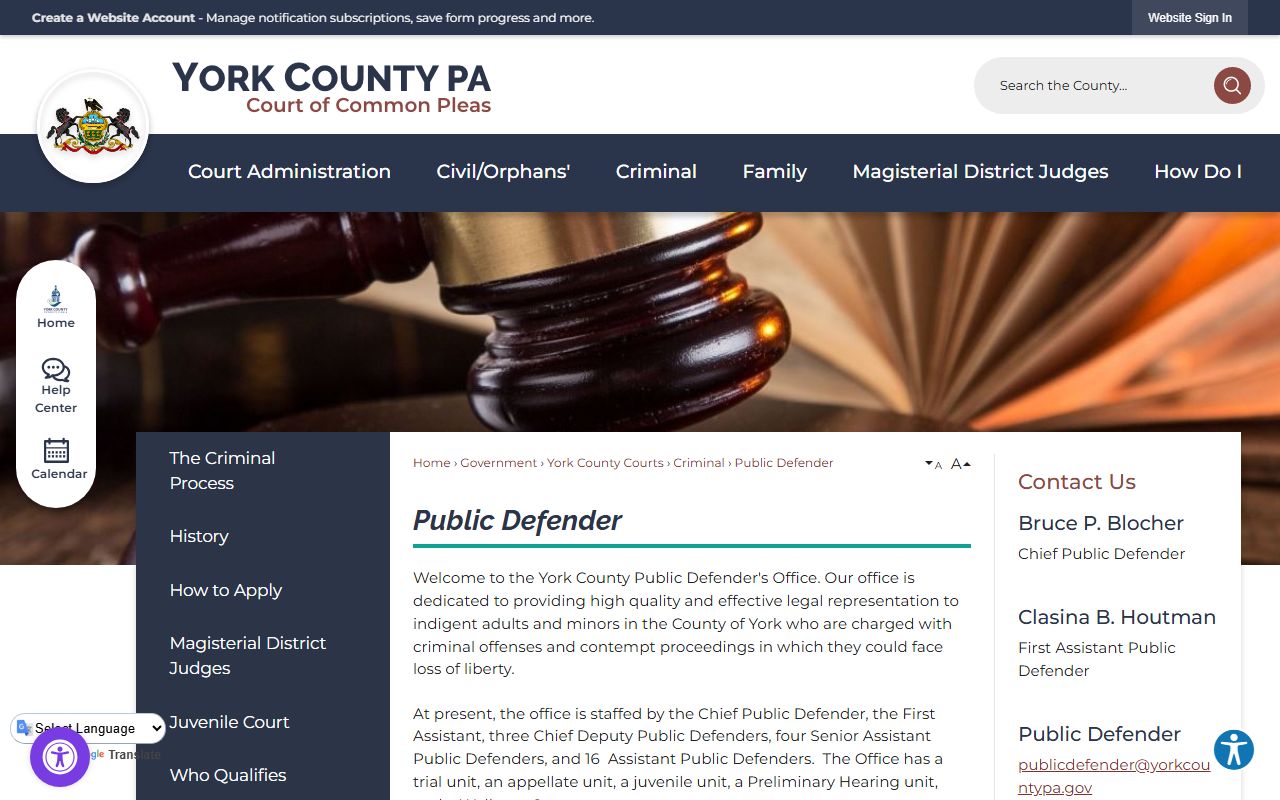
Chief Public Defender Bruce P. Blocher leads that office at 45 N George Street, York, PA 17401, phone 717-771-9217. You can also reach the office by email at publicdefender@yorkcountypa.gov. The office does not handle most traffic citations, family matters, or landlord-tenant cases, so plan to look elsewhere for those.
Charges vs. Convictions
This is the most common mistake people make when they read a record. An arrest or a charge is just an accusation. It means an officer or a prosecutor believes a crime took place. It does not mean a court agreed. A conviction is different. It is a guilty plea or a guilty verdict. The sentence is the penalty that comes after a conviction, such as jail time, probation, or a fine. So a docket can show a charge and still end with no conviction at all. Read the disposition line on each docket to see how a case truly ended.
| Charge | Conviction | |
|---|---|---|
| Stage | Accusation | Verdict or plea |
| Burden of Proof | Probable cause | Beyond reasonable doubt |
| Public Record | Yes | Yes |
If you qualify for a public defender and want one, act early. The application steps at https://yorkcountypa.gov/362/How-to-Apply spell out what to bring and when. Apply at least 14 days before the next court date and submit your financial documents. There is one extra rule worth noting up front.
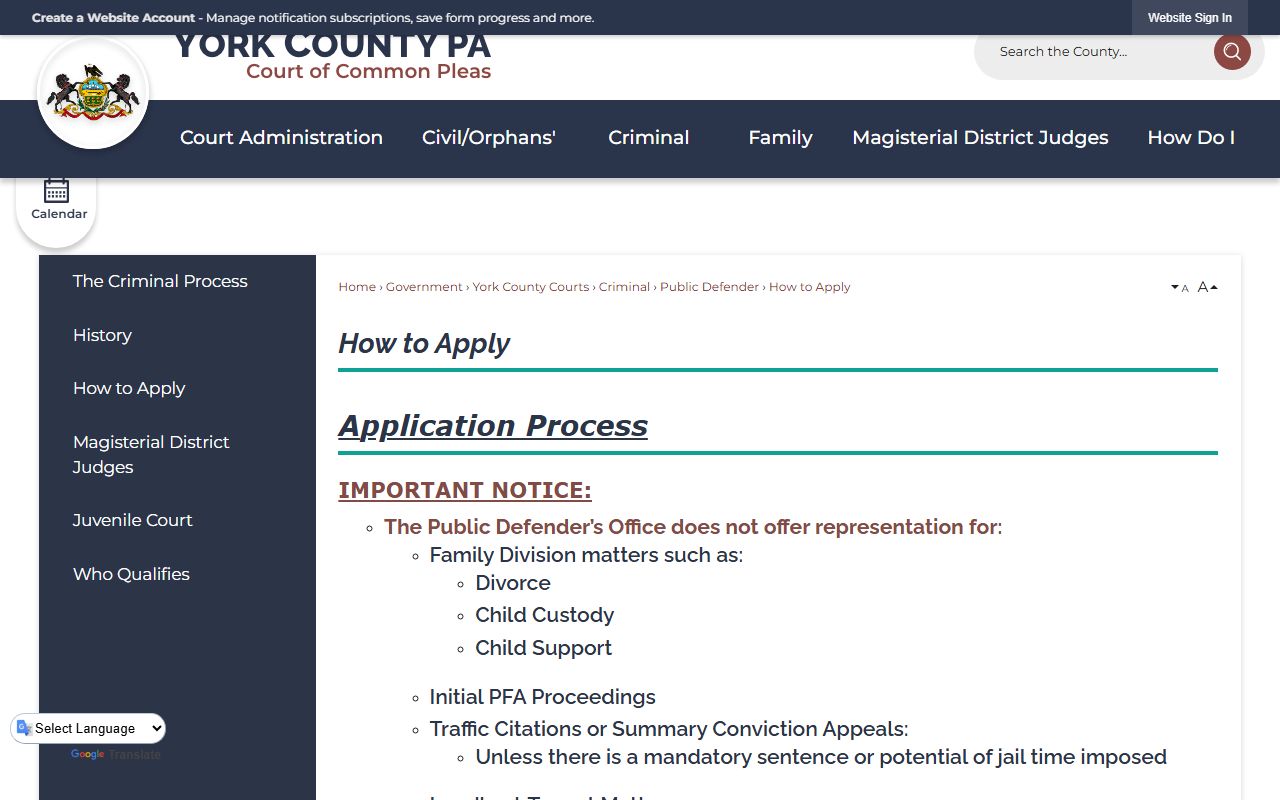
If the applicant has a warrant, the intake must be done in person. That rule keeps the office from processing a case at a distance while a warrant is open. Bring proof of income and any paperwork tied to the charge so the staff can confirm you qualify.
Sealed vs. Expunged Records
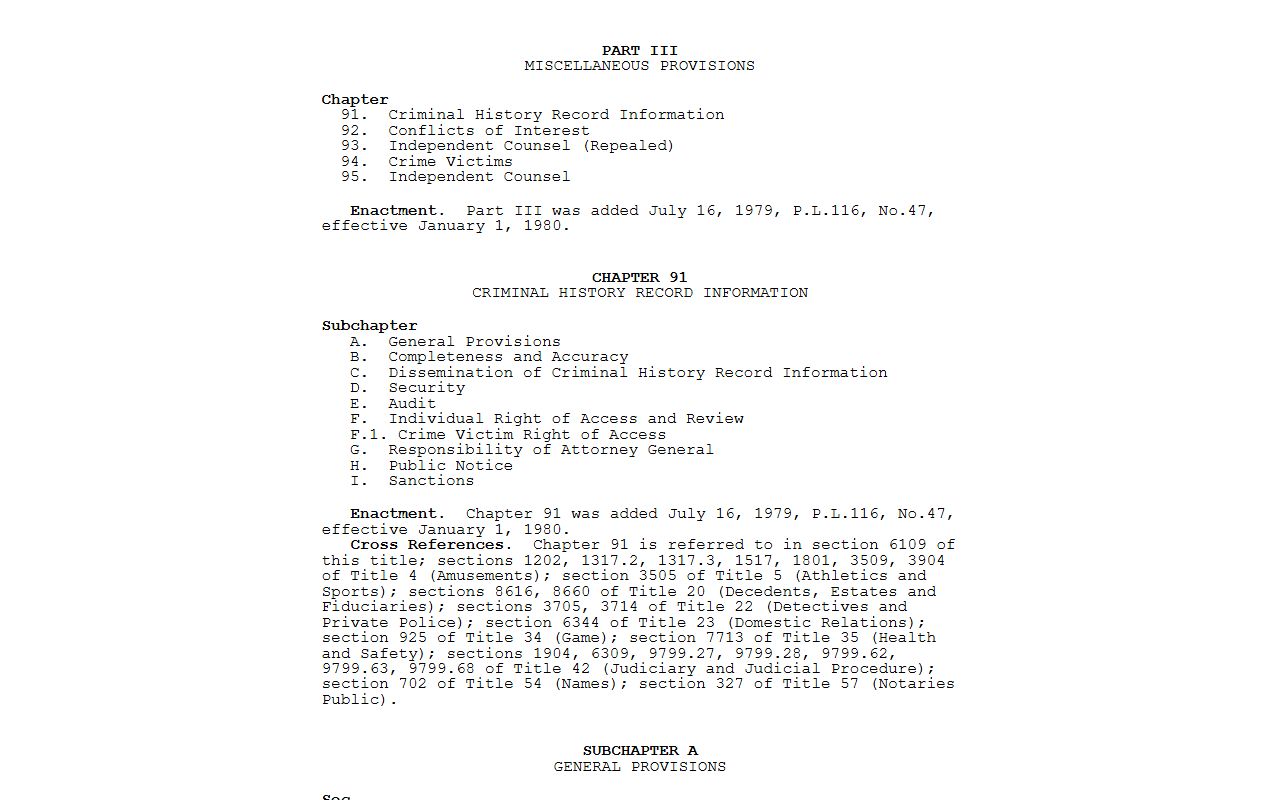
Pennsylvania gives people two main ways to clean up a record. Both are governed by the Criminal History Record Information Act, found at 18 Pa.C.S. Chapter 91. Expungement removes a record from a person's criminal history, though limited copies stay with law enforcement and the courts. Limited access, often called sealing, restricts who can view the record while keeping it on file for certain legal uses. There is also Clean Slate, which can seal eligible records on its own with no petition at all. The line below points to the full text of the law.
You can read the Criminal History Record Information Act at https://www.legis.state.pa.us/WU01/LI/LI/CT/HTM/18/00.091..HTM to see the exact rules for each path.
Filing has a cost. The York County Clerk of Courts charges $215.10 for an expungement petition and $132 for limited access. After a judge signs the order, the Pennsylvania State Police processes the expungement once it receives the signed court order. You can find the state expungement service at https://www.pa.gov/services/psp/apply-for-criminal-record-expungement. The table below sums up how a sealed record differs from one that has been expunged.
| Sealed | Expunged | |
|---|---|---|
| Visibility | Hidden from most public view | Removed from criminal history |
| Retained For | Courts and some agencies | Specified officials only |
| Method | Limited access or Clean Slate | Court petition and PSP order |
Mugshots and Booking Photos
Many people expect a booking photo gallery. York County does not run one. The county does not publish a public booking blotter or a mugshot gallery on its official pages, so do not assume such a tool exists. If a third-party site shows a booking photo, treat it with care, since those photos are often old or tied to a case that has since closed.
To confirm whether a person is held right now, skip the photo search and check custody data instead. The jail and inmate records tools track who is in the York County Prison. That prison houses pretrial detainees as well as people sentenced by the Court of Common Pleas. As a rule, sentences under two years are served in the county prison rather than a state facility.
Statewide Criminal Records Search
Pennsylvania runs one search that reaches every county court. It is the Unified Judicial System (UJS) Case Search at https://ujsportal.pacourts.us/CaseSearch. The tool is free. Because it pulls from courts statewide, you can find a York case even if you are not sure which court handled it. Set the County to York to keep the results local. The site shows docket sheets with charges, dispositions, and sentences, but it does not let you download the underlying documents.
Prosecution in York County runs through the District Attorney's Office. Timothy J. Barker is the York County District Attorney. The office sits at 45 N George Street, 3rd Floor, York, PA 17401, and the phone is 717-771-9600. The DA prosecutes misdemeanor, felony, and homicide cases, taking on about 8,500 new adult cases a year. The staff directory is shown below.
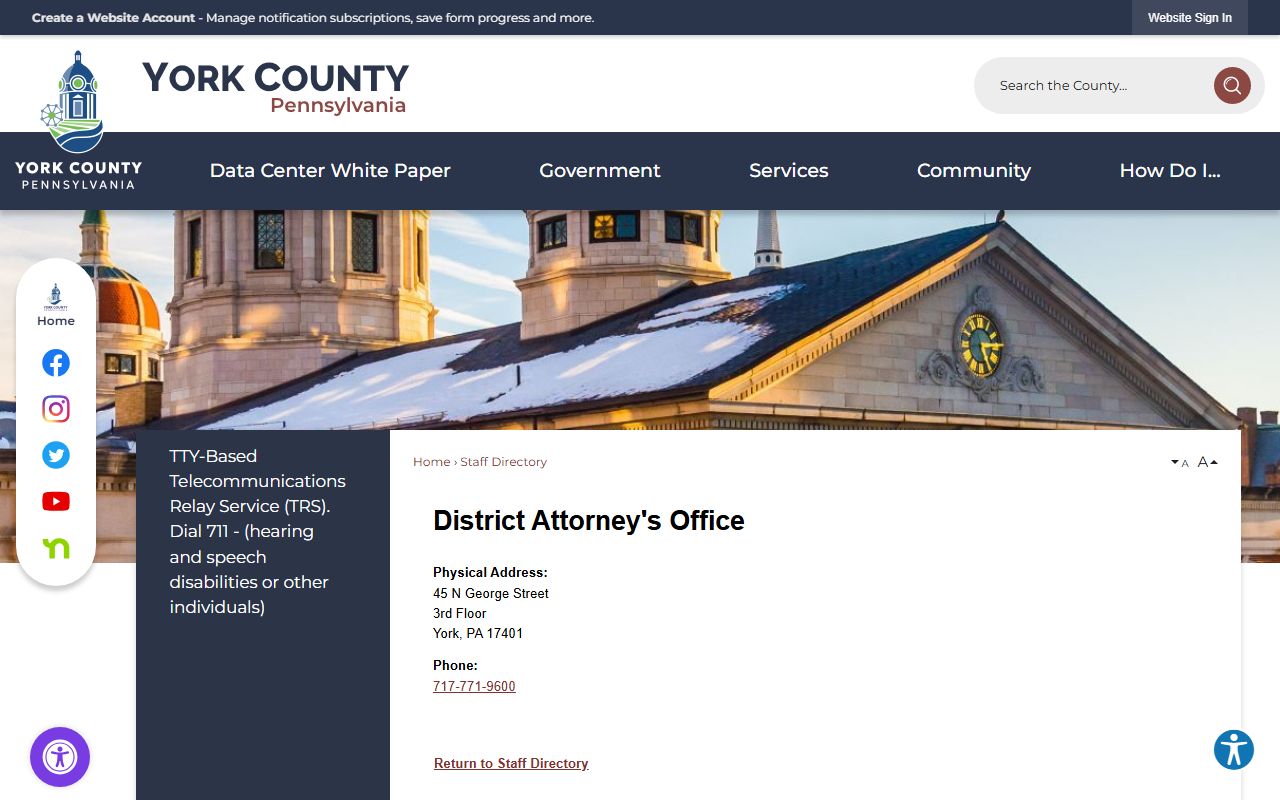
You can browse that directory at https://yorkcountypa.gov/862/District-Attorneys-Office. The office also runs diversion programs such as ARD, short for Accelerated Rehabilitative Disposition, for eligible first-time defendants. For deeper detail on the office and its work, the official DA site is a good next stop.
The York County District Attorney maintains its own public site at https://yorkda.com/. The page below links to that site.
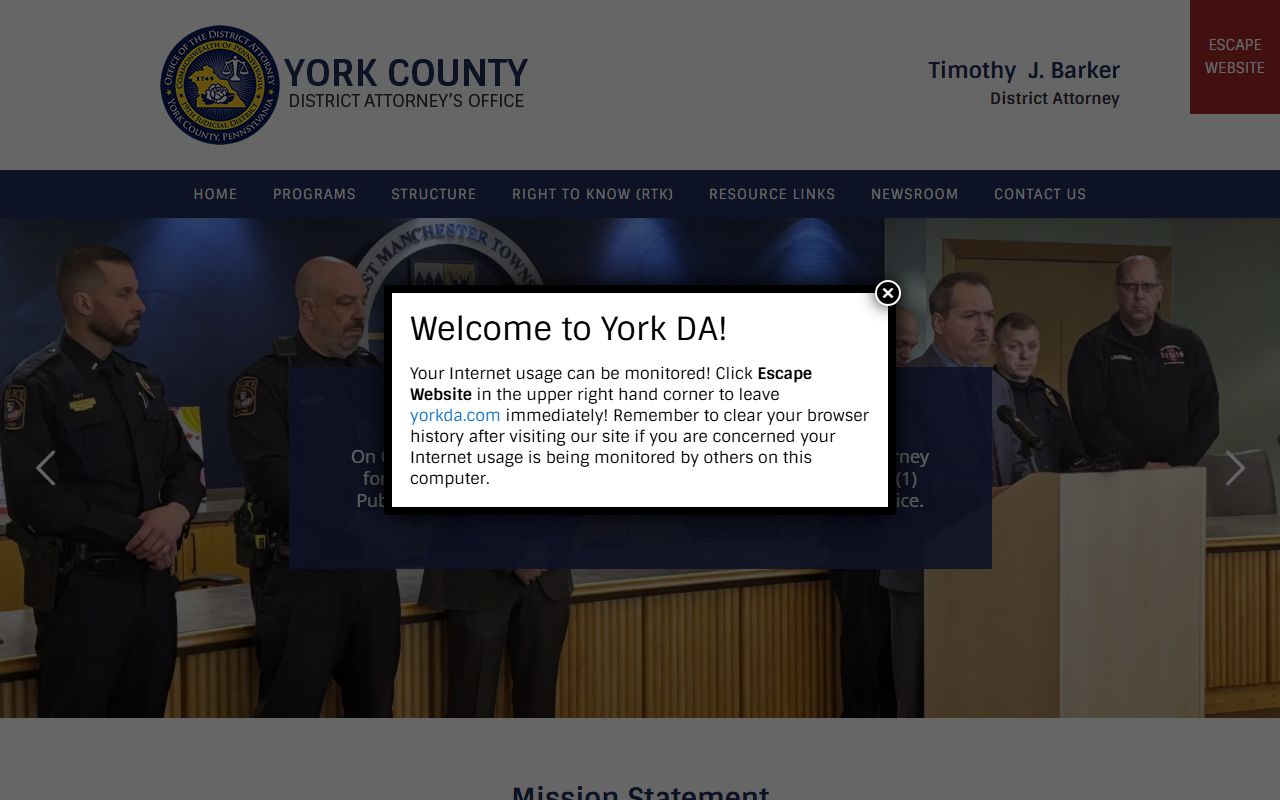
That site covers the office mission, case programs, and contact details. Between the DA site and the UJS portal, you can trace a case from the charge through the disposition without paying a fee.
Background Check Considerations
A casual lookup and a formal background check are not the same thing. Reading a docket on the UJS portal is fine for personal use. But if you plan to use a record to make a hiring, housing, or credit decision, the law treats that as a regulated consumer report. Those checks must follow the Fair Credit Reporting Act. They run through a licensed agency that verifies the data and gives the subject a chance to dispute errors. For an official criminal history, the Pennsylvania State Police is the proper source, and an expungement order is processed only after a judge signs it.
Important: This site is not a consumer reporting agency under the FCRA. Do not use the data here for employment, tenant, credit, or insurance decisions.
Restricted Criminal Records in York County
Not every record is open to the public. Juvenile records are tightly held. Sealed and limited-access records are hidden from most public view, though courts and some agencies can still see them. Cases tied to an open investigation may also stay out of view until the matter is resolved. If you cannot find a case on the UJS portal, one of these limits may apply, or the record may have been expunged.
York County also runs several wellness courts that route eligible defendants away from a standard sentence. These include Drug Court, founded in 1997, Adult Mental Health Court, started in 2005, DUI Court, and Veterans Treatment Court. Entry is by referral. A case that moves into one of these programs may read differently on the docket than a typical criminal file. For minor driving offenses that do not become criminal cases, the traffic court records page is the better tool.